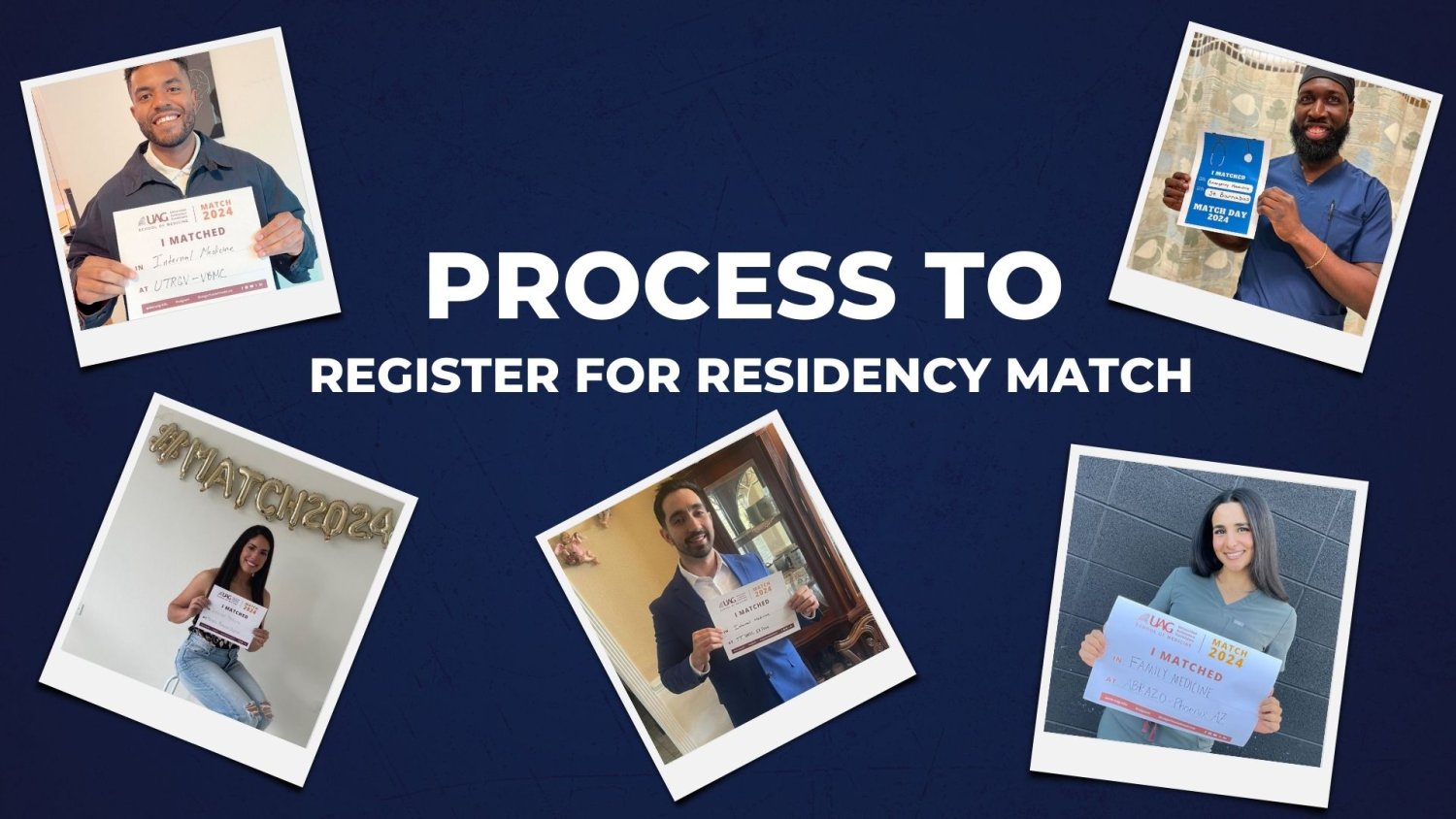
As a student or graduate of UAG, you have the opportunity to apply to various matching programs to obtain a residency position. Although the registration process for the residency match can be daunting, understanding each step can make the process more manageable and less stressful. This article provides an overview of the match registration process with a focus on NRMP/ERAS.
UAG provides an important partner for UAG match applicants: the Office of Graduate Affairs and Career Advising (GACA)). GACA supports UAG applicants on their journey to residency by providing match resources as well as valuable one-on-one residency advising. GACA also holds webinars on all match topics discussed in this article.
Match Eligibility
Applicants are considered match-eligible if they have passed the NBME CBSE by the time UAG’s Match Notification is emailed in the fall before the match application opens. For example, the 2027 Match Notification is sent to potential UAG match applicants in October 2025—the application for the 2027 Match opens in June 2026—applicants find out if they matched in March 2027. Therefore, if entering the 2027 Match, USMLE Step 1 should be taken by March 2026 and USMLE Step 2 no later than July 2026. Note international medical graduates have additional requirements such as ECFMG certification.
Understanding the Residency Match Process
The residency match process matches medical school graduates primarily with residency programs across the United States and Canada. The key entities involved in the residency matching are
-National Resident Matching Program® (NRMP)
-Educational Commission for Foreign Medical Graduates® (ECFMG)
-Electronic Residency Application Service® (ERAS)
-San Francisco Match for ophthalmology or plastic surgery (SFMatch)
-Urology Match – Specific for urology applicants
-ResidencyCAS – Centralized Application Service
-CentralApp for plastic surgery
Steps to Complete Residency Applications
Prepare Required Documents
Before submitting your match application, you must first submit an MSPE (Medical Student Performance Evaluation) and transcript request to UAG in the fall before the application season opens. You will request letters of recommendation from preceptors, attendings, and department chairs to support your application and are advised to have letter writers upload letters on your behalf. , a You will write a specialty-specific personal statement and create a CV. You will authorize your USMLE transcripts to be released to ERAS, where you will assign them to programs. Make sure that these documents are up-to-date and reflect your qualifications accurately.
Application Timeline
•Request your MSPE and transcript from UAG.
• Research – Investigate the various residency programs.
• Personal Statement – Write a personal statement tailored to each specialty you’re applying to.
• CV—Make sure your CV is complete and up to date.
• Letters of Recommendation – Obtain letters from attendings, preceptors, and chairs.
• Register with NRMP.
• ECFMG – Register and upload your information, including a photo, through OASIS.
• OET – Complete the Occupational English Test for ECFMG Certification.
• ECFMG Certification – Apply via the Pathways.
• ERAS Application – Complete your application through ERAS.
• Apply to programs – Submit your applications to programs of interest via ERAS.
• Rank Order List – Submit your Rank Order List (ROL) through NRMP.
Requirements for ERAS/NRMP Matching Service
The following must be submitted to the matching service by UAG and can only be provided after the applicant submits a request:
• MSPE and transcript
The following must be provided by the applicant:
• Application forms and payment, including an ERAS Token; applicants must purchase a Token to register for and use the ERAS application system
• Personal Statement(s)
• Current CV
• Photo of the applicant
• USMLE/Board Scores (provided via the USMLE transcripts request)
• Letters of Recommendation—These letters should be from attendings, preceptors, or chairs.
Prepare for Interviews
After submitting your application, residency programs will review it and may invite you for interviews. Prepare for these interviews by researching the programs, practicing common interview questions, and reflecting on your career goals. GACA offers mock interviews to help you polish your listening and speaking skills. Interviews are a critical part of the match process, allowing both you and the programs to assess fit and compatibility.
Rank Your Preferred Programs
If you are applying to the NRMP, following your interviews, you will rank the residency programs in order of preference through the NRMP portal. The programs will also rank applicants. The NRMP then uses an algorithm to match students with programs based on these rankings.
Program Signaling in ERAS
A program signal allows applicants to express their interest in a residency program. In turn, program signals are used by programs as a tool for holistic applicant review. Like other match topics, UAG applicants can learn more about program signaling during GACA’s Planning Your Match webinar.
Plan for Residency
Once you have matched, begin planning for your residency. This includes finalizing your graduation requirements, securing housing, and preparing for the transition to residency. Contact your matched program to receive information about orientation, start dates, and any other requirements.
Registering for the various matching programs is a multi-step process that requires careful planning and attention to detail. By understanding the steps involved and preparing thoroughly, you can navigate this process successfully and secure a residency position that aligns with your career goals.
GACA stays in touch with match applicants throughout the season to support their journey; when applying to the match, be sure to read GACA communications, schedule advisement, submit documents on time, and attend match webinars to avoid knowledge gaps about this critical process of becoming a practicing physician. Your journey. Our guidance.
CONTÁCTANOS
Compártenos tus intereses y en breve un asesor educativo se pondrá en contacto contigo.